


IT | EN







The “renaissance” of the immensely wealthy and ambitious states of the Middle East continues to astonish with bold political, architectural, artistic, and technological initiatives that are reshaping the global geography of cultural destinations. The arrival in Qatar, during the first week of February, of the prestigious Art Basel fair — which has expanded from Basel to Miami, Hong Kong, Paris, and now Doha — is the latest sign of its unstoppable development.
Landing at Doha airport and encountering Urs Fischer’s gigantic yellow bear, one gisimmediately senses that Qatar is a country that assigns great importance to art.
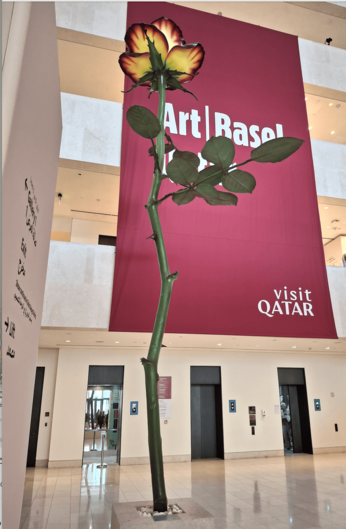
Entering the heart of the city, one encounters its two most iconic museums: the Museum of Islamic Art designed by I.M. Pei (also architect of the Louvre Pyramid) and the National Museum of Qatar by Jean Nouvel. It is therefore no surprise that Art Basel has found here a fertile and well-prepared ground, also thanks to the vision of Sheikha Al Mayassa, the Emir’s sister, who considers art a tool for global dialogue and actively supports major cultural initiatives. The chosen theme, “Becoming,” appears perfectly aligned with a country undergoing rapid transformation and with a humanity in constant evolution. The artistic directors of the event, Shawky and De Bellis, proposed an innovative format: a limited number of exhibitors, galleries devoted to single artists, and generous open spaces, with the aim of encouraging deeper attention and authentic engagement from the public. At the main entrance, a monumental rose by Isa Genzken welcomed visitors with a presence both imposing and delicate, symbolically marking the threshold to the exhibition space. The fair did not unfold within a single pavilion but across multiple venues distributed throughout the cultural and creative district: a second space hosted additional galleries and installations, while artworks placed along the connecting routes transformed the surrounding streets into an integral part of the artistic experience. Within this platform — inevitably also commercial, with prices ranging from a few thousand to several million dollars — 87 galleries from 31 countries came together, including 16 new participants. Alongside major international names such as Picasso, Basquiat, Boetti, Baselitz, Christo, and Kounellis, the fair featured leading and emerging artists from the Middle East, North Africa, and South Asia, including Iman Issa, Etel Adnan, Simone Fattal, Hassan Sharif, Ali Banisadr, Ali Cherri, Manal Al Dowayan, and Lina Gazzaz. A fair that was clear, accessible, and thoughtfully organized, capable of combining international ambition with regional identity. More than a simple debut, this edition sends a precise message: Doha does not merely wish to host major events — it aims to establish itself as one of the new global hubs of contemporary culture.