

IT | EN







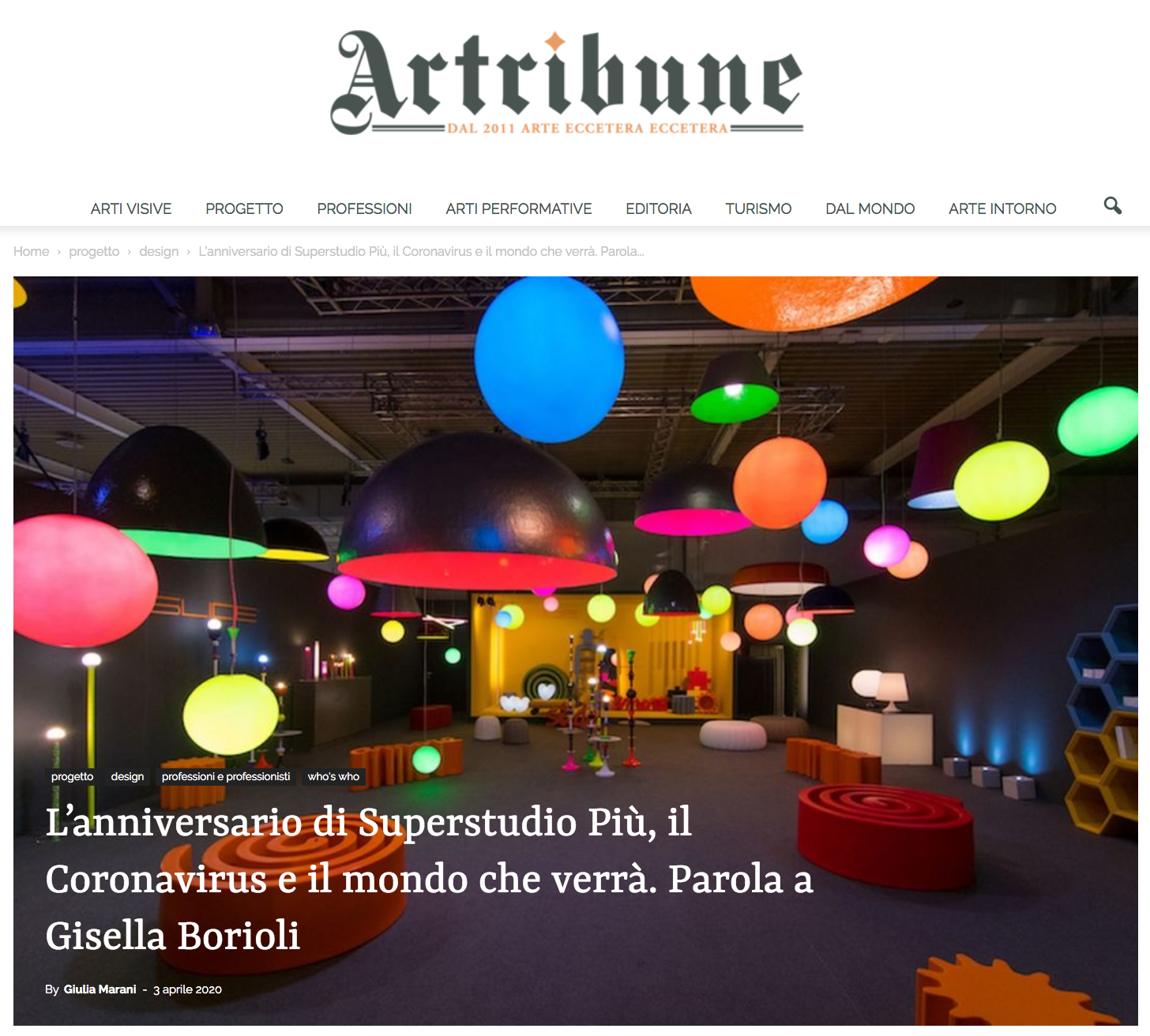
In Milan everyone remembers that April 2000 where in an unknown via Tortona, in a disused factory, a surprise alternative and almost playful way of presenting the design complementary to what the Salone del Mobile did with its trade fair with an important commercial function arose. Thus begins the adventure of Gisella Borioli in design in the new Superstudio Più, with the complicity and the adhesion of her friend Giulio Cappellini, entrepreneur and open-minded talent-scout . Artribune wanted to make the point with an interview with the founder.
Twenty years have passed since the creation of Superstudio Più and the first design presentation, with Cappellini and a series of young designers who later became stars. What are the memories you are most attached to?
I remember with surprise when I called Giulio Cappellini, with whom I had previously collaborated for my Donna magazine, to see the portion of the delabré factory just bought by General Electric. It was just over a month before the start of the Salone del Mobile 2000 in which he thought to show the new products of Cappellini in a booth as usual. He was totally smitten with the charm of the large central hall, which we then called Central Point, and he decided immediately to cancel the Fiera participation to bring to Superstudio, in a spectacular way, products and prototypes from all the known and lesser-known designers he was working with. At that time via Tortona was considered suburban and Superstudio was known only for the photographic studios of via Forcella. The rest were factories warehouses and labs in the process of being decommissioned. And banister houses for workers. I was the first to wonder about his bravery.
Superstudio Più is also a privileged observatory on the design system. How has it changed in these twenty years?
To sum up, the design, seen by us, has dematerialized and has became technological. Presentations, from commercial, are now cultural and emotional. Planning has faced the new complexity with digital design, parametric, immaterial. The companies landscape has become globalised, including more and more distant countries that have become first-person producers as contractors. Furniture and objects have become more eclectic, playful, experimental. Technology brought new materials, facilitated new functions. Attention has shifted from home to environment, from aesthetics to sustainability. The famous architects who collaborate with large companies have been joined by young makers who think design produce communicate and often sell independently. Purchase motivation is no longer just that product fulfils a function but that it also knows how to tell a story. And design has become an alibi that adds surplus value and appeal to every product: not only to furniture, as it used to be, but to bags, toothbrushes, pots and dishes, cars, loudspeakers, carpets, food, fashion, even sex toys, etc.
The Salone del Mobile announced that the 2020 edition is postponed to 2021. What impact will this stop have on Milan design?
One might say: dramatic. But the world of design and its creative people is unpredictable, strong, enthusiastic, smart. I am sure that companies and designers will react vigorously to this moment of black-out and they will have reason to find their way back and renew the system.
What about Milano tout court? The city that never stops had to stop for reasons of force majeure, interrupting what seemed an endless cultural rise…
Milan will recover. And the shock will make it more human, supportive, better. Its architects are already transforming it into a smart city of the future, by incorporating new architectures with historical buildings. The health drama lesson will make them more careful to the environment and safety. I believe that architects will be the first responsible for a Milan able to give new answers.
A board composed of several actors of Fuorisalone is organizing to develop a digital proposal shared on the dates when the design week was supposed to take place. What are you working on?
The committee of independent planners is taking steps not to drop the attention on design in 2020 with the weapons that are peculiar, those of communication and events. There is the project of a digital program that can offer opportunities for coordinated and planned visibility to protagonists and companies. And the idea of creating another "physical" appointment in the city, in autumn. But I wouldn’t call it an extra Fuorisalone, but rather a new occasion which could be called in another way. The real Fuorisalone is and remains the contemporary and complementary one to Salone at the fair. The strength of the two events together is what made Milan Design Week the week of greatest appeal to the world. Dismember it for me it wouldn’t make sense. For an eventual autumn project we are thinking of a "trailer" of what we will see in 2021 dedicated to female creativity.
Among the projects of Superdesign Show there was an exhibition dedicated to female design, for which a call was launched. Would you recommend three women designers or artists to keep an eye on?
Our research for designers and artists is still open and I would not like to anticipate names now. I can mention three well-known designers who for me represent female creativity, that is a mix of rationality, imagination, function, vision, decoration and even romance. Paola Navone, Nina Zupanc, Elena Salmistraro. All three were welcome guests of Superstudio.
We don’t know how long this crisis is going to last, but there's already someone who is wondering about the aftermath. Someone has proposed a return to active life in different times for age groups, someone else who is the first to re-enter are women, who seem to be less seriously affected by the coronavirus. What do you think? Could it be a way to begin to smooth out the gender gap that also exists in design?
The selection based on age or other differences seems to me a bit racist. The gender gap cannot be forced with artifice. Beyond the recovery, we must invite women to be more present and I would say insistent in proposing their projects. But above all to encourage the business leaders, men generally, to be more brave and open and to understand how much value and how many possibilities architects can express. Since it is women who then choose mainly what to put in the house, then who better than them can interpret the desires and needs of new products?
How are you spending this lock down?
Working. I’m finishing the book of our anniversary: 2000/2020 DESIGN SUPERSHOW/EVOLUTION AND MISE-EN-SCÈNE OF DESIGN AT SUPERSTUDIO IN MILAN. A testimony of all the most significant appearances we have had in twenty years. I am the author but for the graphic project I chose… my husband, Flavio Lucchini, who despite his 90 years ( or perhaps for this reason) is still a great teacher.
From ARTRIBUNE: www.artribune.com/progettazione/design/2020/04/superstudio-piu-intervista-gisella-borioli