


IT | EN







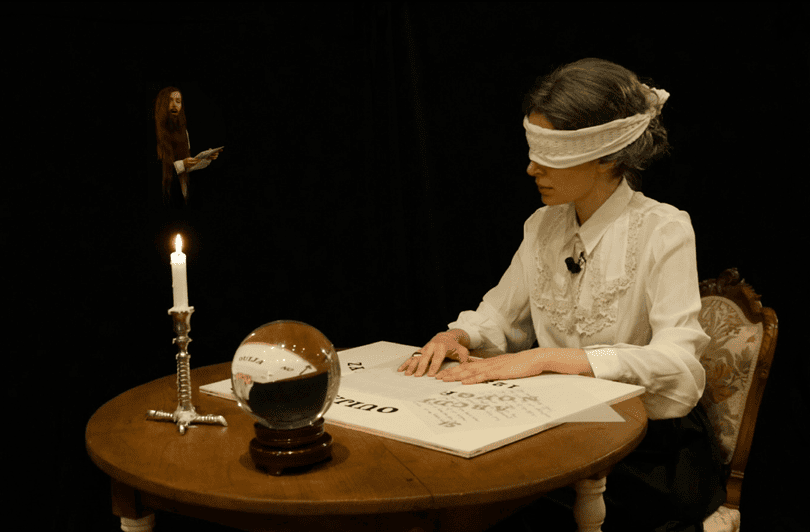
The Nicola Trussardi Foundation explores the city of Milan with unusual exhibitions in ever-changing locations. This time it has landed at Palazzo Morando - which, not by chance, was inaugurated on the female-focused path precisely by Gisella Borioli as curator in 2007 with the exhibition “Divina! Maria Callas tra Moda e Mito” - the visionary exhibition “Fata Morgana: memoria dall’invisibile” curated by Massimiliano Gioni, Daniel Birnbaum, former directors of the Venice Art Biennale, and Marta Papini. And the mystery is revealed in all its forms.
Let’s think about it. Everything always manifests itself as a matter of feminine intuition and foresight, when speaking of Palazzo Morando in Milan, the noble residence of Countess Lydia Caprara Morando Attendolo Bolognini.
The countess (1876–1945) already had by nature a rather independent temperament ahead of her time, equally divided between charity, activism, and spiritualism. And her mansion on Sant’Andrea Street, which she herself donated to the Municipality of Milan, has always been at the center of a cultural program attentive to the special powers of special women. Today more than ever, all this is highlighted by opening its doors to a new exhibition, skillfully pop and sophisticated, entitled Fata Morgana: memoria dall’invisibile.
A review that intertwines history, art and mysticism, offering us visions, ecstasies, meditations, apparitions and alternative imaginaries, and inviting us to explore the relationship between creativity, the occult and spirituality. Ranging from historical “visionaries” such as the Swedish Hilma af Klint (today rediscovered artistic and feminist icon), Emma Kunz, Carol Rama, Man Ray, and Pierre Klossowski, and reaching the multifaceted, modern and multimedia mysticisms of Judy Chicago, Andra Ursuța, Diego Marcon and Chiara Fumai, the much-missed Roman performer whose magical 2015 video The Book of Evil Spirits is shown here.
The exhibition pays homage to a mythical sorceress, portrayed in conflict with male power. But it also alludes to the famous poem that Breton dedicated to her in 1940: today as then, we live in years of great innovations but equally great uncertainties and cruelties, today as then, mental drifts and radical alternatives to dominant rationality become enticing. In short, here is the mystery served: to illustrate how in certain moments of our history divergent thought, especially that of women artists, manages to break down conventions and redraw the future with beauty. Certainly, today the relationship between technology, spirituality and power has become infinitely more dangerous...
Fata Morgana: memoria dall’invisibile.
Nicola Trussardi Foundation.
Palazzo Morando, Via Sant'Andrea 6, Milan
October 8 - November 30